Why the Future of AI Isn’t About Better Models—It’s About Better Loops
Every week a new AI model arrives.
A larger context window.
A better benchmark score.
A more impressive demo.
The industry conversation usually follows the same pattern:
- Is GPT-5 better than Claude?
- Is Claude better than Gemini?
- Is Gemini better than Qwen?
- Which model should we use?
But after building and deploying enterprise AI systems, I have come to a different conclusion: The biggest bottleneck in AI systems is no longer the model. It is the loop.
The organizations creating the most successful AI products in 2026 are not winning because they have access to better models. They are winning because they have built better feedback loops around those models.
The model generates intelligence. The loop compounds intelligence. And those are very different things.
A Production Story: Two AI Systems, Same Model, Different Outcome
Recently, I worked with two AI-powered support systems.
- Both used the same foundation model.
- Both used Retrieval-Augmented Generation (RAG).
- Both had access to the same enterprise knowledge base.
- Both delivered excellent results during testing.
Six months later, one was succeeding and one was struggling.
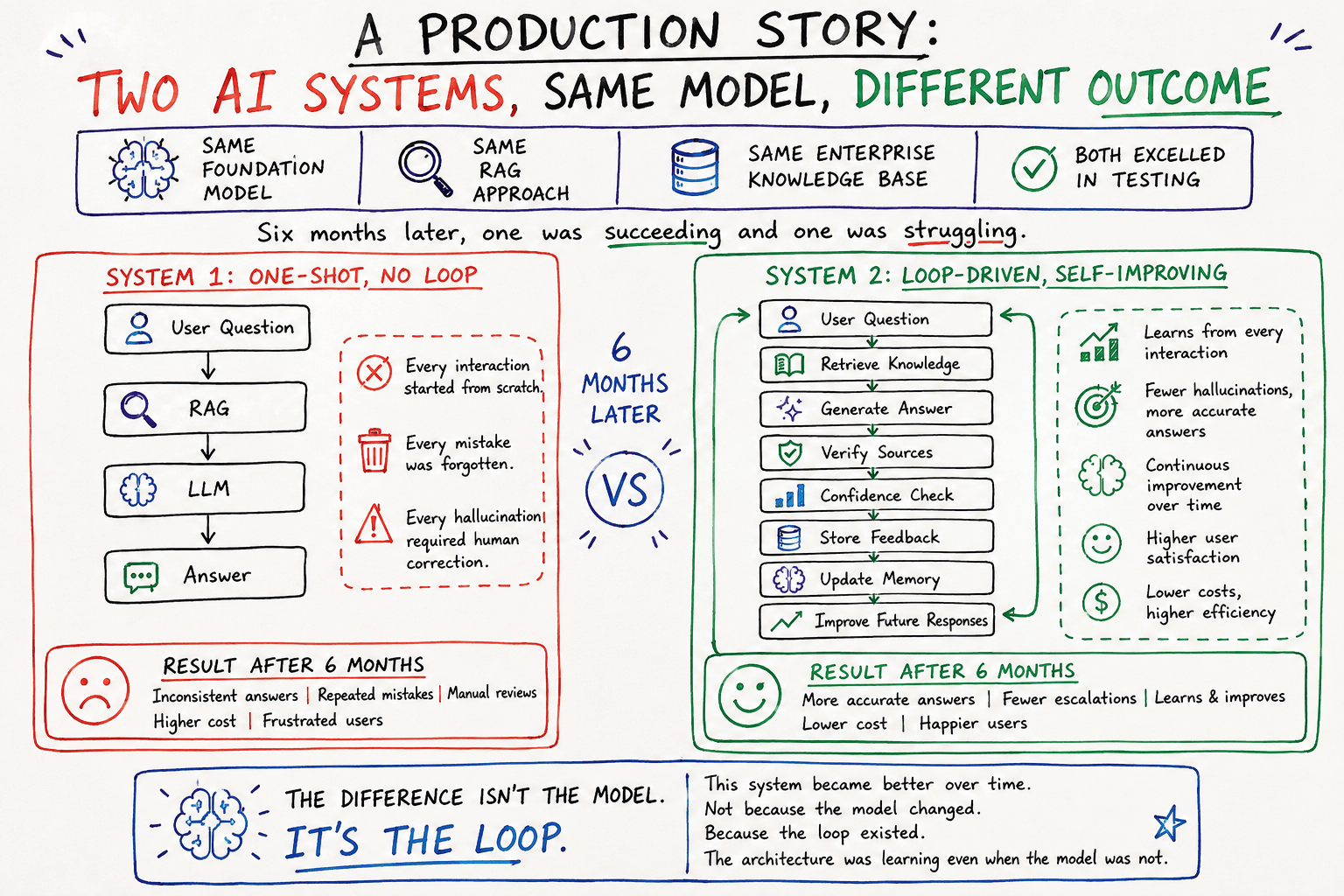
This system became better over time. Not because the model changed. Because the loop existed. The architecture was learning even when the model was not.
The Evolution of AI Systems

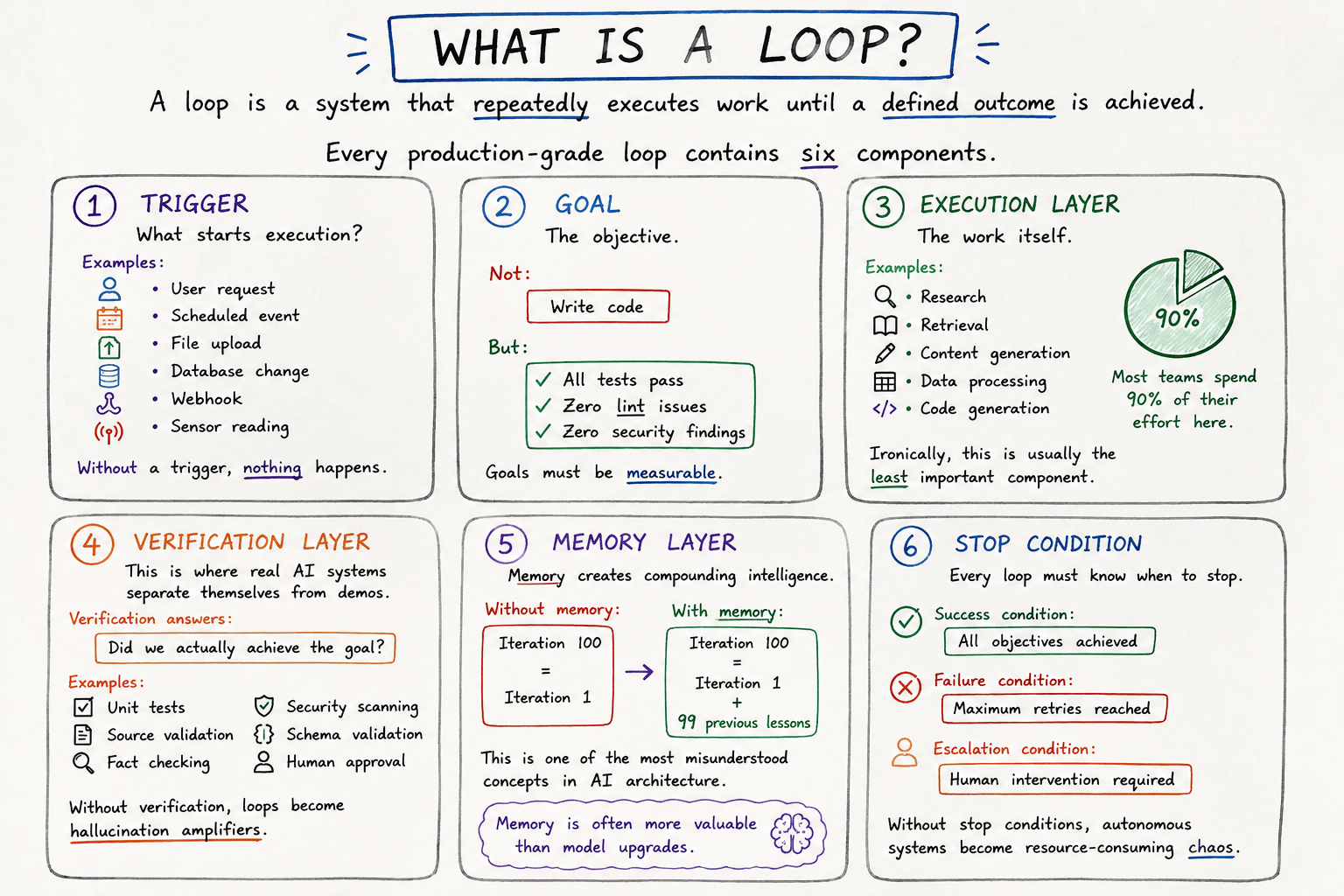
What Is a Loop?
A loop is a system that repeatedly executes work until a defined outcome is achieved. Every production-grade loop contains six components.
Why Verification Is More Important Than Generation

Notice what changed. The model became less important. The loop became more important. This is why many organizations are discovering that a smaller model with strong verification often outperforms a frontier model without it.
The Rise of Multi-Agent Loop Systems

-
Each agent operates inside its own loop.
-
Each verifies the previous stage.
-
Each contributes specialized intelligence.
-
This architecture resembles enterprise organizations more than chatbots. And that is exactly where AI is heading.
Real Enterprise Example: Healthcare AIOS
Why Loops Are the Foundation of AI Operating Systems?
Reference – Healthcare AIOS: Designing an AI Operating System for the Future of Healthcare

The system continuously:
- Collects logs
- Correlates telemetry
- Identifies root causes
- Suggests fixes
- Verifies remediation
- Escalates when needed
This is not theoretical. This is how next-generation AI operations platforms are being designed.
Final Thoughts
The AI industry spent the last three years obsessing over models.

The next three years will be about systems.

The companies that dominate AI will not necessarily have the smartest models.

They will have the best architectures.

The most effective memory systems.

The strongest verification layers.

And the most intelligent loops.

Because intelligence alone does not scale.

Feedback does.

Learning does.

Loops do.
Happy Learning!!
Further Reading
If you found this article useful, you may also enjoy these related deep dives on AI infrastructure, context management, model optimization, and enterprise AI architecture:
The LLM Infrastructure Architect’s Guide Series
- The LLM Infrastructure Architect’s Guide — Part 1
https://medium.com/@patriwala/the-llm-infrastructure-architects-guide-part1-d725f9ceef23 - The LLM Infrastructure Architect’s Guide — Part 2
https://medium.com/@patriwala/the-llm-infrastructure-architects-guide-part2-f440235b7fe7 - The LLM Infrastructure Architect’s Guide — Part 3
https://medium.com/@patriwala/the-llm-infrastructure-architects-guide-part-3-bc0f8189b8d5 - The LLM Infrastructure Architect’s Guide — Part 4
https://medium.com/@patriwala/the-llm-infrastructure-architects-guide-part-4-c13b27a77e46 - The LLM Infrastructure Architect’s Guide — Part 5
https://medium.com/@patriwala/the-llm-infrastructure-architects-guide-part-5-eac9260f533d
Related Articles
The Art of Context Management: Strategic Approaches When LLMs Hit Their Memory Limits
A practical guide to token budgeting, context compression, memory strategies, and handling long-running AI conversations.
https://medium.com/@patriwala/the-art-of-context-management-strategic-approaches-when-llms-hit-their-memory-limits-2b361805b586
AWQ vs GPTQ: A Practical Decision Framework for LLM Quantization
Learn how quantization impacts model size, inference speed, memory consumption, and deployment decisions.
https://medium.com/gopenai/awq-vs-gptq-a-practical-decision-framework-for-llm-quantization-e8538e4c486f
Run AI Models On Device Without The Cloud — Microsoft Foundry Local
Explore local AI deployment patterns and how inference architecture is evolving beyond cloud-only approaches.
https://medium.com/@patriwala/run-ai-models-on-device-without-the-cloud-microsoft-foundry-local-7d7474cfd684
AI Data Classification Framework: The Essential Layer Between AI Innovation and Enterprise Risk
Understand how governance, compliance, and data classification impact enterprise AI systems.
https://medium.com/@patriwala/ai-data-classification-framework-the-essential-layer-between-ai-innovation-and-enterprise-risk-a5be1ff17b55
Why Cloud Architects Remain One of the Most Critical Roles in the AI Era
A look at why AI success increasingly depends on infrastructure architecture, scalability, security, and operational excellence.
https://medium.com/@patriwala/why-cloud-architects-remain-one-of-the-most-critical-roles-in-ai-era-3ec3dadbbb22
Leave a Reply